
BMI Calculator
Body mass index (BMI) relates weight to height. Enter a height and weight in U.S. or metric units.
Adult BMI categories
| BMI | Category |
|---|---|
| Below 18.5 | Underweight |
| 18.5 to 24.9 | Normal weight |
| 25.0 to 29.9 | Overweight |
| 30.0 to 34.9 | Obesity (class I) |
| 35.0 to 39.9 | Obesity (class II) |
| 40.0 and above | Extreme obesity (class III) |
BMI chart
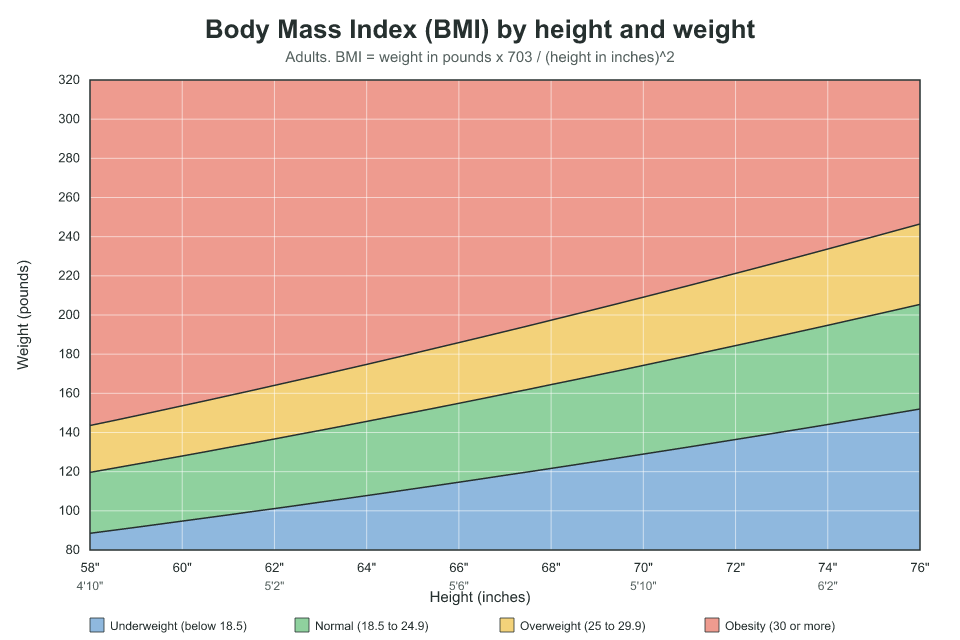
BMI is a screening number, not a diagnosis. It does not separate muscle from fat and does not by itself describe a person's health. This is an archived reference tool, not medical advice.
Assessing weight and health risk
Assessing Your Weight and Health Risk
Assessment of weight and health risk involves using three key measures:
- Body mass index (BMI)
- Waist circumference
- Risk factors for diseases and conditions associated with obesity
Body Mass Index (BMI)
BMI is a useful measure of overweight and obesity. It is calculated from your height and weight. BMI is an estimate of body fat and a good gauge of your risk for diseases that can occur with more body fat. The higher your BMI, the higher your risk for certain diseases such as heart disease, high blood pressure, type 2 diabetes, gallstones, breathing problems, and certain cancers.
Although BMI can be used for most men and women, it does have some limits:
- It may overestimate body fat in athletes and others who have a muscular build.
- It may underestimate body fat in older persons and others who have lost muscle.
Use the BMI Calculator or BMI Tables to estimate your body fat. The BMI score means the following:
| BMI | |
|---|---|
| Underweight | Below 18.5 |
| Normal | 18.5–24.9 |
| Overweight | 25.0–29.9 |
| Obesity | 30.0 and Above |
Waist Circumference
Measuring waist circumference helps screen for possible health risks that come with overweight and obesity. If most of your fat is around your waist rather than at your hips, you’re at a higher risk for heart disease and type 2 diabetes. This risk goes up with a waist size that is greater than 35 inches for women or greater than 40 inches for men. To correctly measure your waist, stand and place a tape measure around your middle, just above your hipbones. Measure your waist just after you breathe out.
The table Risks of Obesity-Associated Diseases by BMI and Waist Circumference provides you with an idea of whether your BMI combined with your waist circumference increases your risk for developing obesity-associated diseases or conditions.Risk Factors for Health Topics Associated With Obesity
Along with being overweight or obese, the following conditions will put you at greater risk for heart disease and other conditions:
Risk Factors
- High blood pressure (hypertension)
- High LDL cholesterol ("bad" cholesterol)
- Low HDL cholesterol ("good" cholesterol)
- High triglycerides
- High blood glucose (sugar)
- Family history of premature heart disease
- Physical inactivity
- Cigarette smoking
For people who are considered obese (BMI greater than or equal to 30) or those who are overweight (BMI of 25 to 29.9) and have two or more risk factors, it is recommended that you lose weight. Even a small weight loss (between 5 and 10 percent of your current weight) will help lower your risk of developing diseases associated with obesity. People who are overweight, do not have a high waist measurement, and have fewer than two risk factors may need to prevent further weight gain rather than lose weight.
Talk to your doctor to see whether you are at an increased risk and whether you should lose weight. Your doctor will evaluate your BMI, waist measurement, and other risk factors for heart disease.
The good news is even a small weight loss (between 5 and 10 percent of your current weight) will help lower your risk of developing those diseases.
Healthy Weight Tip
Waist circumference can help assess your weight and associated health risk.
Check Your BMI
Screen shot of BMI calculator The BMI Calculator is an easy-to-use online tool to help you estimate body fat. The higher your BMI, the higher your risk of obesity-related disease.
BMI, waist circumference and disease risk
The archived classification table below pairs each BMI category with waist circumference. It is reproduced from a 2013 copy of the page the old site's BMI links led to.
Classification of Overweight and Obesity by BMI, Waist Circumference, and Associated Disease Risks
| Disease Risk* Relative to Normal Weight and Waist Circumference | ||||
|---|---|---|---|---|
|
BMI (kg/m2) |
Obesity Class |
Men 102 cm (40 in) or less Women 88 cm (35 in) or less |
Men > 102 cm (40 in) Women > 88 cm (35 in) |
|
| Underweight | < 18.5 | - | - | |
| Normal | 18.5–24.9 | - | - | |
| Overweight | 25.0–29.9 | Increased | High | |
| Obesity | 30.0–34.9 | I | High | Very High |
| 35.0–39.9 | II | Very High | Very High | |
| Extreme Obesity | 40.0 + | III | Extremely High | Extremely High |
* Disease risk for type 2 diabetes,
hypertension, and CVD.
+ Increased waist circumference also can be a marker for increased risk, even in persons of normal weight.
Sources
- Clinical Guidelines on the Identification, Evaluation, and Treatment of Overweight and Obesity in Adults: The Evidence Report. National Institutes of Health; 1998 (BMI = weight in kilograms divided by height in meters squared; classification cut points 18.5, 25, 30, 35 and 40).
- The chart on this page was drawn for this site from those cut points and the formula weight in pounds = BMI x height in inches squared / 703.