
| Text Size: | |||||
| |||||

 , (196 KB)
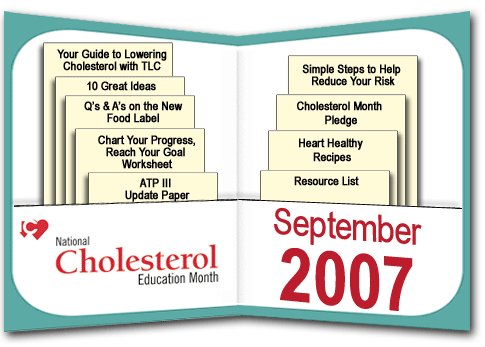
The kit, page by page
Know Your Numbers - Know Your Risk: 10 Great Ideas for Promoting National Cholesterol Education Month (2007 National Cholesterol Education Month Kit)
|
10 Great Ideas for Promoting | |||||||||||||||||||||

1. | Make it easy for people to access the booklet, Your Guide to Lowering Your Cholesterol With TLC (Therapeutic Lifestyle Changes):
|
2. | Encourage your family, friends, and coworkers to have their cholesterol checked. Hand out the Chart your progress - Reach your goal worksheet so they can record their cholesterol numbers. |
3. | Contact your worksite health and fitness center and/or local congregation and ask them to cosponsor a cholesterol screening fair. |
4. | Send out a broadcast email with a link to the 10-year Risk Calculator. Encourage everyone to know their cholesterol numbers and to know their risk for heart disease. |
5. | Send out a weekly e-mail about preventing heart disease that contains a link to the Lifestyle Section of the Live Healthier, Live Longer Web page. |
6. | Decorate a bulletin board in your facility using the theme "Know Your Cholesterol Numbers—Know Your Risk—Give Yourself Some TLC." Post various cholesterol resources and educational flyers on the board. |
7. | Hand out Simple Steps to Help Reduce Your Risk. |
8. | Set aside 30 minutes each Monday afternoon during Cholesterol Month to participate in a group walk around your building or neighborhood. Try to repeat this 30-minute stroll on your own on most days of the week. |
9. | Sponsor a best recipe contest. See who can prepare the best tasting, low saturated fat, low cholesterol dish. Award a $10 grocery store gift certificate to the top three winners. (Ask the grocery store to donate the gift certificate). Get started with some of these heart healthy recipes. |
10. | Coordinate with your local grocery store and a local dietitian to give a grocery store tour demonstrating how to read food labels and choose heart healthy foods |
• Kit Page • Kit Contents
• •
Know Your Numbers - Know Your Risk: Feature Article (2002 National Cholesterol Education Month Kit)
|
How do your cholesterol numbers measure up? Your numbers are crucial for knowing your chance of having a heart attack. In September, National Cholesterol Education Month, have your cholesterol checked. Then, find out your risk for heart disease—and how to lower it.
In addition, people with metabolic syndrome—a cluster of risk factors such as obesity, high triglyceride levels, and a low HDL level—may need additional treatment after reaching their LDL treatment goal. For more information, visit the NCEP Web page (www.nhlbi.nih.gov/chd). LDL Cholesterol Goals Based on Risk Categories
* other than LDL | |||||||||
| • NCEP Page • Kit Page • Kit Contents Note to users of screen readers and other assistive technologies: Please report problems here. | |||||||||

Know Your Numbers - Know Your Risk: Online Kit Contents (2007 National Cholesterol Education Month Kit)
|
Online Kit Contents. . . There are many exciting types of information in NCEP KIT 2007 for use by the public and health professionals alike. Each piece is different, so be sure to take the time to explore each one.
| |
| • Kit Page • Kit Contents |
Know Your Numbers - Know Your Risk: Cholesterol Month Pledge (2007 National Cholesterol Education Month Kit)
| | |||||||||||||||||||

 | To know my/our cholesterol numbers, including total cholesterol, LDL cholesterol, HDL cholesterol, and triglycerides. |
| To find out what my/our 10-year risk for heart disease is and to find out what my/our LDL cholesterol goal should be. |
| To read food labels at the grocery store and to purchase primarily foods that are low in saturated fat, trans fat, and cholesterol. |
| To pay more attention to hidden saturated fat, trans fat, and cholesterol in baked goods and foods eaten on the run. |
| To learn what my/our body mass index is and to lose weight, if overweight, and to take measures to maintain a healthy weight. |
| To participate in physical activity of moderate intensity — like brisk walking — for at least 30 minutes on most or all days of the week. On days when I/we don’t have time, I/we will do the activity in three, 10-minute segments during the day. |
| To remain tobacco-free or, if I/we smoke, pick a quit date and ask my/our healthcare provider for help with quitting. |
| ______________________________ | ______________________________ |
| ______________________________ | ______________________________ |
• Kit Page • Kit Contents
• •
Know Your Numbers - Know Your Risk: Drop-in Article (2003 National Cholesterol Education Month Kit)
| Drop-in article September is National Cholesterol Education MonthNational Cholesterol Education Month 2003 continues the theme, "Know your cholesterol numbers, know your risk." This theme echoes two of the main thrusts of the latest cholesterol guidelines entitled, "Third Report of the National Cholesterol Education Program (NCEP) Expert Panel on Detection, Evaluation, and Treatment of High Blood Cholesterol in Adults" (Adult Treatment Panel III, or ATP III). These guidelines provide the most up-to-date recommendations on clinical cholesterol management for health care professionals. September, National Cholesterol Education Month, is a particularly good time to motivate individuals to get their cholesterol checked, know their numbers, and know their risk of developing coronary heart disease (CHD). Latest NCEP Guidelines: ATP IIIATP III, the first major update in cholesterol management from the NCEP in nearly a decade, follows the principles of previous panel reports. Important concepts from the previous cholesterol guidelines report, ATP II, such as aggressively treating elevated low density lipoprotein (LDL) cholesterol in persons with CHD, remain in place. ATP III is evidence-based and contains a number of new features. Some of the key changes in the ATP III guidelines include:
As in previous ATP reports, LDL cholesterol continues to be the primary target of therapy. Recent clinical trials affirm that lowering LDL cholesterol reduces the short-term risk for heart disease by as much as 40 percent, and the long-term reduction in risk may be even greater. Risk Assessment in ATP IIIATP III espouses the principle that the intensity of cholesterol-lowering treatment should be matched to the person's level of risk for CHD. Risk assessment in ATP III involves several straightforward steps. First, a complete lipoprotein profile (total cholesterol, LDL, HDL, and triglycerides) is obtained after a 9- to 12-hour fast. Second, the presence of clinical atherosclerotic disease (clinical CHD, carotid artery disease, peripheral arterial disease, abdominal aortic aneurysm) is identified. Clinical atherosclerotic disease is considered a CHD risk equivalent, meaning that it confers the same high risk for CHD events as in those who already have CHD. Third, the presence of major risk factors other than LDL is determined. The major risk factors exclusive of LDL are listed below:
Note: In ATP III, diabetes is considered a CHD risk equivalent because persons with diabetes have virtually as high a risk of having a heart attack as someone who already has CHD. Finally, if two or more risk factors (other than LDL) are present without CHD or CHD risk equivalent, Framingham risk scoring is used to estimate short-term (10-year) risk. Framingham risk scoring uses age, total cholesterol level, smoking status, HDL level, and systolic blood pressure to estimate 10-year risk for heart disease. ATP III divides those with multiple risk factors into three categories based on their 10-year risk for CHD: >20%, 10-20%, and <10%. The LDL goal of therapy is based on which of three categories of CHD risk the individual falls into:
Cholesterol-Lowering Therapy: Therapeutic Lifestyle ChangesATP III recommends a multifaceted lifestyle approach to reducing cholesterol. This approach is termed therapeutic lifestyle changes (TLC) and includes the TLC diet, weight management, and physical activity. TLC is for anyone whose LDL is above their goal level. The TLC diet is a low saturated fat, low cholesterol eating plan that calls for less than 7% of calories from saturated fat and less than 200 mg of dietary cholesterol per day. The TLC diet recommends only enough calories to maintain a desirable weight and to avoid weight gain. Increased amounts of viscous (soluble) fiber as well as food products containing plant stanols/sterols (such as cholesterol-lowering margarines) can also be added to the TLC diet to boost its LDL-lowering power. The other TLC components are weight management (especially for those who are overweight or obese) and increased physical activity. For additional information on TLC, visit the interactive "Live Healthier, Live Longer" Web page (www.nhlbi.nih.gov/chd/). Cholesterol-Lowering Drug TherapyWhile TLC alone may lower the LDL to goal in many persons, others (especially those with multiple risk factors and those with CHD or a CHD risk equivalent) may need a combination of TLC and drug therapy to lower their LDL cholesterol to goal. The choice of drug or drugs used will depend on the individual's lipid profile. The statins are a frequently prescribed group of drugs that effectively lower LDL cholesterol and are safe for most users. In clinical trials, LDL cholesterol lowering with statins has been shown to decrease the rate of heart attacks and deaths from CHD by approximately 30%. Statins have been shown to be effective in persons with or without CHD. To assist professionals in understanding the current recommendations for use and monitoring of statins, a clinical advisory on statins has been developed. Bile acid sequestrants also lower LDL cholesterol and can be used alone or in combination with statin drugs. Nicotinic acid (or niacin) lowers LDL cholesterol and triglycerides and raises HDL cholesterol. Nicotinic acid in doses large enough to lower cholesterol can cause side effects and should only be used under the supervision of a physician. Fibric acids are used mainly to treat high triglycerides and low HDL. Regardless of the type of drug therapy used, individuals should take an active part in their health care. In order to maximize cholesterol lowering, TLC should always be maintained when drug therapy is prescribed. The Metabolic SyndromeThe metabolic syndrome, which affects about one-quarter of all adults in the U.S., has emerged as just as strong a contributor to early heart disease as cigarette smoking. The metabolic syndrome, also known as syndrome X or insulin resistance syndrome, is a constellation of metabolic risk factors that significantly increases the risk for coronary events. The metabolic syndrome is identified by the presence of three or more of the following: abdominal obesity (waist circumference >40 inches in men or >35 inches in women); triglycerides ATP III Implementation ToolsTo help ensure implementation of the ATP III guidelines, the NCEP has developed an array of products and tools to accelerate their adoption into practice. For professionals, these aids include an executive summary that synopsizes the evidence and recommendations; a PowerPoint® slide show for teaching the guidelines to professional audiences; an ATP III At-A-Glance Desk Reference that outlines basic action steps; an interactive tool for Palm OS devices that is designed for use at the point of care; a 10-year CHD risk calculator available in online and downloadable (Excel spreadsheet) versions; and a clinical advisory on statins. To empower patients to be active partners in their care, NCEP has developed a new patient booklet entitled "High Blood Cholesterol—What You Need to Know;" a 10-year CHD risk calculator for lay audiences; and an updated Web page "Live Healthier, Live Longer" that reflects the new information in ATP III. All of these tools are available on the ATP III Web page (www.nhlbi.nih.gov/guidelines/cholesterol/). Several of the ATP III products are also available in hard copy at the NHLBI Health Information Network Online Catalog (http://emall.nhlbihin.net). NCEP Jumpstarts Implementation of Latest GuidelinesTo promote the adoption of the ATP III guidelines, the National Heart, Lung, and Blood Institute (NHLBI) and the National Committee for Quality Assurance (NCQA) jointly sponsored a national conference, "Advances in Cholesterol Management: Putting the New National Cholesterol Education Program Guidelines into Practice." Portions of the conference were Webcast and may be viewed online at the ATP III Web page. | |
| • NCEP Page • Kit Page • Kit Contents Note to users of screen readers and other assistive technologies: Please report problems here. |
 140/90 mmHg or on antihypertensive medication).
 20% have an LDL goal of <130 mg/dL.
Know Your Numbers - Know Your Risk: Education Materials (2002 National Cholesterol Education Month Kit)
To Order Cholesterol Education Materials | |
| • NCEP Page • Kit Page • Kit Contents Note to users of screen readers and other assistive technologies: Please report problems here. |
Know Your Numbers - Know Your Risk: Welcome Letter (2002 National Cholesterol Education Month Kit)
| Dear Colleague: Thank you for your interest in and support for National Cholesterol Education Month. Cholesterol Month 2003 continues the theme, "Know your cholesterol numbers, know your risk." This theme highlights two of the main thrusts of the latest cholesterol guidelines, clearly emphasizing the importance of having your cholesterol measured and knowing your risk of developing heart disease. This year's Cholesterol Month kit contains a variety of materials and tools that will assist you in bringing the latest information on cholesterol lowering into your community, program, or practice. Cholesterol Month is an especially good time to recharge your cholesterol education activities. Build your activities on the latest National Cholesterol Education Program (NCEP) guidelines for cholesterol management: the "Third Report of the National Cholesterol Education Program Expert Panel on Detection, Evaluation, and Treatment of High Blood Cholesterol in Adults" (Adult Treatment Panel III, or ATP III). ATP III, which was developed by an expert panel of 27 members and extensively reviewed by the members of the NCEP Coordinating Committee representing 40 leading health and medical organizations, as well as by 19 additional cholesterol authorities, is evidence-based and heavily referenced. ATP III maintains many core principles of ATP II, including a focus on LDL cholesterol as the primary target of therapy, and the need for intensive cholesterol treatment in patients with coronary heart disease (CHD). Naturally, ATP III also has a number of new features, including: more aggressive cholesterol-lowering treatment and better identification of those at high risk for a heart attack; use of a complete lipoprotein profile as the first test for high cholesterol; a new level at which low HDL cholesterol becomes a major heart disease risk factor; a new set of "Therapeutic Lifestyle Changes," with more power to improve cholesterol levels; a sharper focus on a cluster of heart disease risk factors known as "the metabolic syndrome;" and increased attention to the treatment of high triglycerides. To assist in the implementation of the ATP III guidelines, several new tools have been developed. For professionals, a risk assessment tool for calculating the risk for having a heart attack in the next 10 years, an interactive guideline tool for Palm OS® devices, an ATP III At-A-Glance Quick Desk Reference, and a clinical advisory on statins are available at the NHLBI ATP III Web page (www.nhlbi.nih.gov/guidelines/cholesterol/). Patients also can assess their risk by using an online risk calculator, or by using the Framingham risk scoring tables in the brochure, "High Blood Cholesterol—What You Need To Know," also available at the NHLBI ATP III Web page (www.nhlbi.nih.gov/guidelines/cholesterol/). The interactive Web page "Live Healthier, Live Longer" (www.nhlbi.nih.gov/chd/) has been updated to reflect the ATP III guidelines. It provides detailed information on lowering cholesterol for those who want to prevent CHD, as well as those who already have CHD and want to reduce their risk for a heart attack. Your 2003 Cholesterol Month community kit includes the essential tools and materials to broadcast this year's theme, "Know your cholesterol numbers, know your risk." Some of the helpful items contained in your kit include:
These are just a few of the materials in your Cholesterol Month kit. Be sure to check out each piece offered. Thank you for using the 2003 Cholesterol Month kit in supporting National Cholesterol Education Month through your organization's activities in September and throughout the year. Sincerely, James I. Cleeman, M.D. | |
| • NCEP Page • Kit Page • Kit Contents Note to users of screen readers and other assistive technologies: Please report problems here. |
Know Your Numbers - Know Your Risk: 10 Great Ideas for Promoting National Cholesterol Education Month (2007 National Cholesterol Education Month Kit)
Questions and Answers About the New Food Label: | |||||||||||||||||||||||||
Q. | A Food and Drug Administration (FDA) rule requires that food labels list the amount of trans fat together with saturated fat and cholesterol. What is trans fat? |
A. | Trans fat is a type of fat that is formed when vegetable oil is hardened through a process called hydrogenation. This process helps makes foods more solid, gives them shape, and prolongs their shelf life. |
Q. | What do saturated fat, trans fat, and cholesterol in foods have to do with heart disease? |
A. | Saturated fat, trans fat, and cholesterol in the diet all raise the level of LDL "bad" cholesterol in the blood. The higher the LDL cholesterol, the greater the risk for coronary heart disease (CHD), the main form of heart disease and a leading cause of death, illness, and disability in the United States. Saturated fat and trans fat raise LDL similarly, but Americans consume 4-5 times as much saturated fat as trans fat. Saturated fat is the chief dietary culprit that raises LDL, but consumers need to know about all 3 - saturated fat, trans fat, and cholesterol - in the foods they eat to reduce their risk for CHD and stay heart-healthy. |
Q. | What foods contain saturated fat, trans fat, and cholesterol? |
A. | High amounts of saturated fat are found in animal products, such as fatty cuts of meat, chicken skin, and full-fat dairy products like butter, whole milk, cream, and cheese, and in tropical vegetable oils such as palm, palm kernel, and coconut oil. Trans fat is found in some of the same foods as saturated fat, such as vegetable shortening, some margarines (especially hard or stick margarine), crackers, cookies, baked goods, fried foods, and other processed foods made with partially hydrogenated vegetable oils. Small amounts of trans fat also occur naturally in some animal products, such as milk products, beef, and lamb. Foods high in cholesterol include liver, other organ meats, egg yolks, shrimp, and full-fat dairy products. |
Q. | How is the new nutrition label on foods different? |
| A. | The FDA's rule requires that the amount of trans fat be listed on a separate line under saturated fat on the Nutrition Facts panel of the food label. The new label enables consumers to know the amount of saturated fat, trans fat, and cholesterol in a serving of the food they eat. |
Q. | How can I use the new food label to make heart-healthy food choices? |
A. | Check the Nutrition Facts panel of the food label. Choose foods lower in saturated fat, trans fat, and cholesterol. For saturated fat and cholesterol, you can also use the Percent Daily Value (%DV): 5% DV or less is low, and 20% DV or more is high. (There is no %DV for trans fat.) |
Q. | Is it better to eat butter instead of margarine to avoid trans fat? |
A. | No. The combined amount of saturated fat, trans fat, and cholesterol in butter is usually higher than in margarine, even though some margarines contain more trans fat than butter. There are margarines available that contain no trans fat. Soft (tub) or liquid margarine usually contains less trans fat than hard (stick) margarine and less saturated fat and cholesterol than butter. |
• Kit Page • Kit Contents
• •
Know Your Numbers - Know Your Risk: Heart-Healthy Recipes (2004 National Cholesterol Education Month Kit)
|
To access any of the cookbooks, simply click on the cookbook title. From there, you will be connected directly to the Web page where you can download the entire cookbook or selected recipes. Heart-Healthy Home Cooking: African American StyleNothing beats home-style cooking. The Heart-Healthy Home Cooking Cookbook contains over 20 recipes that will help you prepare home-style meals the healthy way, low in saturated fat, cholesterol, and calories. All recipes can be prepared using simple, everyday ingredients. These recipes may be low in saturated fat and cholesterol, but they certainly are not low in taste. Recipes in the booklet include southern barbecued chicken, savory potato salad, classic macaroni and cheese, and sweet potato pie. NIH Publication No. 97-3792. Delicious Heart Healthy Latino RecipesThese recipes can help you prepare your favorite, traditional Latino dishes in a heart healthy way. This bilingual cookbook contains 23 tested recipes that cut down on fat, cholesterol, and sodium but not on taste. Who knew that by substituting a few key ingredients, traditional Latino dishes can be transformed into heart-healthy meals the entire family can enjoy? NIH Publication No. 96-4049.
| |
| • NCEP Page • Kit Page • Kit Contents |

 Stay Young at Heart Recipe Cards
Know Your Numbers - Know Your Risk: Resource List (2007 National Cholesterol Education Month Kit)
National Cholesterol Education Month | |
| • Kit Page • Kit Contents |
 You can contact the following associations, Government agencies, and clearinghouses for additional information and materials about cholesterol and cholesterol lowering.
Know Your Numbers - Know Your Risk: Simple Steps to Help Reduce Your Risk (2007 National Cholesterol Education Month Kit)
| | |||||||||||||||||||

 | Get a fasting lipoprotein profile to find out what your total cholesterol, LDL cholesterol, HDL cholesterol, and triglyceride numbers are. |
| Calculate your risk for heart disease using the ATP III assessment tool. |
| Discuss your risk for heart disease with your physician or other health care provider and take steps to reduce the risk factors that put you at risk. |
| Learn how to read a food label - Choose foods that are low in saturated fat, trans fat, and cholesterol. |
| Read High Blood Cholesterol—What You Need to Know to learn what your cholesterol means to you. |
| If you have high blood cholesterol, use the guide to lower your cholesterol with TLC (therapeutic lifestyle changes). |
| Calculate your body mass index (BMI) with the BMI calculator and see how your weight measures up. |
| Participate in physical activity of moderate intensity—like brisk walking—for at least 30 minutes on most, and preferably all, days of the week. No time? Break the 30 minutes into three, 10-minute segments during the day. Visit the Virtual Fitness Room. |
| Don't smoke. If you do smoke, contact your healthcare provider to discuss ways in which they can help you quit. |
• Kit Page • Kit Contents
• •
Know Your Numbers - Know Your Risk: Chart Your Progress - Reach Your Goal (2007 National Cholesterol Education Month Kit)
Chart Your Progress - Reach Your Goal
Repeat Test:
Repeat Test:
| ||||||||||||||||||||||||||||||||||||||||||||||||||||||||||||||||||||||||||||||||||||||||
| • Kit Page • Kit Contents | ||||||||||||||||||||||||||||||||||||||||||||||||||||||||||||||||||||||||||||||||||||||||
Archived page, reproduced from a 2010 copy. It is reference material, not current guidance.